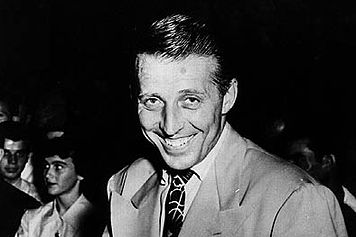
One thing that really stands out to me is that a great portion of the jazz community nowadays doesn't really appreciate Kenton's music for what it is. Sure, people remain aware of the long-running stereotypes about Kenton's various outlets: the bombast, the perceived lack of swing, the pomposity, the vague and at times hilariously goofy names of his bands. But what people don't remember nowadays is how flat-out controversial Kenton's music was. As far as I'm concerned, his career ranks right up there with Thelonious Monk, John Coltrane, Ornette Coleman and John Zorn in terms of the massive divides he was successfully able to create within the jazz community.
I'll be sure to delve more into my thoughts on all of this as this series of posts continues to develop, however long it ends up going on. Before I get too much into that, however, I think it's important to establish a "historical narrative" of sorts as to who Stanley Newcomb Kenton was. Perhaps my psychology teacher father has been rubbing off on me a bit too much, but I've always felt that getting to know the inner workings of an artist is a key step in getting to know their art. There are often many telling similarities between these two things, and the more I've learned about Kenton's life over the years, the more I see him as an almost textbook example for this congruence. Kenton's view of himself as a musical Jedi of sorts, one who was meant to bring balance to the Force of the jazz universe, is a key factor in truly understanding both his musical endeavors and the motivations backing them up.
Our hero's adventure began, as they usually do, inconspicuously enough. Born in Wichita, Kansas on December 11th, 1911, Stanley Newcomb Kenton was the offspring of a prodigiously employed (read: unable to figure out what he wanted to do) father and a college-educated mother. Taking up piano at age 10, he was performing professionally by the time he was in high school. As is the case for all jazz youngsters of the era, Kenton cut his teeth first as a sideman, most notably with the band of Vido Musso, a Sicilian-born tenor saxophonist who would later go on to be a sideman with one of Kenton's earliest outlets.
Always desiring to become a bandleader in his own right, Kenton put together his first group in 1941. This group became known as the Artistry In Rhythm Orchestra, establishing what would become a long-running penchant for overly grandiose titles. Although Kenton clearly possessed enough technical and musical ability to get steady work as early as his teens, his piano playing was never anything to write home about. It was his arranging skills and thoughts about music that really brought about his first major notoriety; indeed, he can almost be considered one of the first important "philosophers of jazz," if you will. Clearly influenced by a sort of Manifest Destiny-esque vision that involved expanding jazz's authoritative reach over classical and (eventually) Afro-Cuban music, Kenton sought to create what could almost be considered a predecessor to what would come to be known as the Third Stream movement over a decade later. This vision would come to include his almost Wagnerian sense of musical grandeur, his propensity for an almost comically powerful brass section, and his devotion to long, complex, almost symphonic structure to his ensemble's various works. He was clearly angling to lead more than just your ordinary, everyday dance band.
It should come as no real surprise that this vision didn't exactly achieve massive success at first. In the WWII era, where the sounds of Glenn Miller and Tommy Dorsey reigned supreme, even the earlier, more palatable Kenton sides came across as bombastic and harsh. To make matters worse, the band was, like many other big bands of the early 1940s, decimated by its members being snatched away by the draft. Perhaps a more ordinary, nondescript upstart bandleader would have caved under these many pressures; Kenton, in a tale reminiscent of Don Quixote, chose to instead throw down the gauntlets and plow forward.
Shockingly enough, this obsessively zealous approach began to pay off. In 1943, four major factors (two commercial, two artistic) led to the once-flagging outlet somehow finding a way to turn its fortunes around. On the commercial front, Kenton began to get his first taste of a national audience. The band briefly took over as comedian Bob Hope's backup band on his popular radio show. Although Kenton had to curb his more artistic inclinations a bit, the band's sound was now being heard by upwards of 40 million Americans through Hope's radio broadcasts. Although Kenton was eventually let go in favor of Les Brown's more traditionally commercial offerings, the damage had been done. Combine this with his new contract with Capitol Records and a hit single with "Eager Beaver," and Kenton's financial viability had taken a drastic turn for the better.
From a more artistic standpoint, Kenton received two key jolts in the arm in 1943. The first came in the form of his first truly great soloist, alto saxophone legend Art Pepper. Just about every major dance band of the Swing Era had to have a featured saxophone soloist, and Pepper's dynamic yet accessible style was just what the doctor ordered. Perhaps even more importantly was the hiring of arranger Pete Rugolo to the band's staff. Rugolo's musical vision was almost one-in-the-same as Kenton's, making him a natural option as a secondary arranger. The key was that Rugolo's technical and theoretical know-how far surpassed those of his employer. With Kenton more than willing to yield the spotlight to his young protege, Rugolo gradually took over more and more of the arranging duties; by the time he stopped regularly writing for Kenton in 1949, he had contributed the vast majority of the band's new charts.
Things only continued to improve for Kenton throughout the mid-1940s. A number of young, cutting edge soloists (such as tenorists Stan Getz and Bob Cooper, trombonist Kai Winding and trumpeter Buddy Childers) found themselves filling out the band's ranks. From a financial standpoint, Kenton was able to pursue more challenging, artistic projects due to a series of popular vocal numbers. At first, these hits were provided by the veteran Anita O'Day; later, it was the youthful June Christy, with her delightful 1945 version of "Tampico" standing out in particular. Between their artistic and commercial successes, life couldn't have been much better for Kenton and his men.
Then, in 1947, it all came to an abrupt stop. Kenton, during a tour of the South, cancelled all future engagements and seemingly shut the band down for good. Reasons for this are varied. One is that Kenton was simply physically exhausted from his seemingly endless touring schedule. Another was his marriage, which was beginning to fall apart at the time of the Southern tour. Yet another was, after undergoing analysis, his surprising announcement of his desire to become a psychiatrist. This absence proved to be short-lived, though, as Kenton returned to work after an approximately 13 week break, only to take another equally unexpected hiatus in 1949; this one ended up lasting a full year. Upon his second return to the music world in 1950, however, Kenton was ready to unleash his most ambitious project yet.
This post is part of a series on the life and music of Stan Kenton. In the next post, I will be discussing the second half of Kenton's career, starting with his Innovations in Modern Music Orchestra.

No comments:
Post a Comment